Rankings on Google Maps change from one neighborhood to the next. One average number hides that, so a grid is the honest way to see where you stand.
What is a local rank tracker?
A local rank tracker answers one question: when someone near me searches for what I do, do I show up? It checks Google Maps from a grid of points, for example 49 points across a 5-mile radius, and records your position at each one. The result is a map of colored dots instead of a single number.
For a roofing, HVAC, plumbing or electrical company, that map is the difference between “we rank well” and “we rank well near our shop and nowhere else.” For the full picture of how an AI receptionist fits a local business, see our AI receptionist for small business guide.
Why is one ranking number misleading?
Google Maps results depend on where the searcher is standing. According to Google's own guidance, local results are based mainly on relevance, distance and prominence. Distance changes with every block, so your position does too. A roofer can rank first near their office and not appear at all a few miles away for the same search.
What does a real map ranking grid look like?
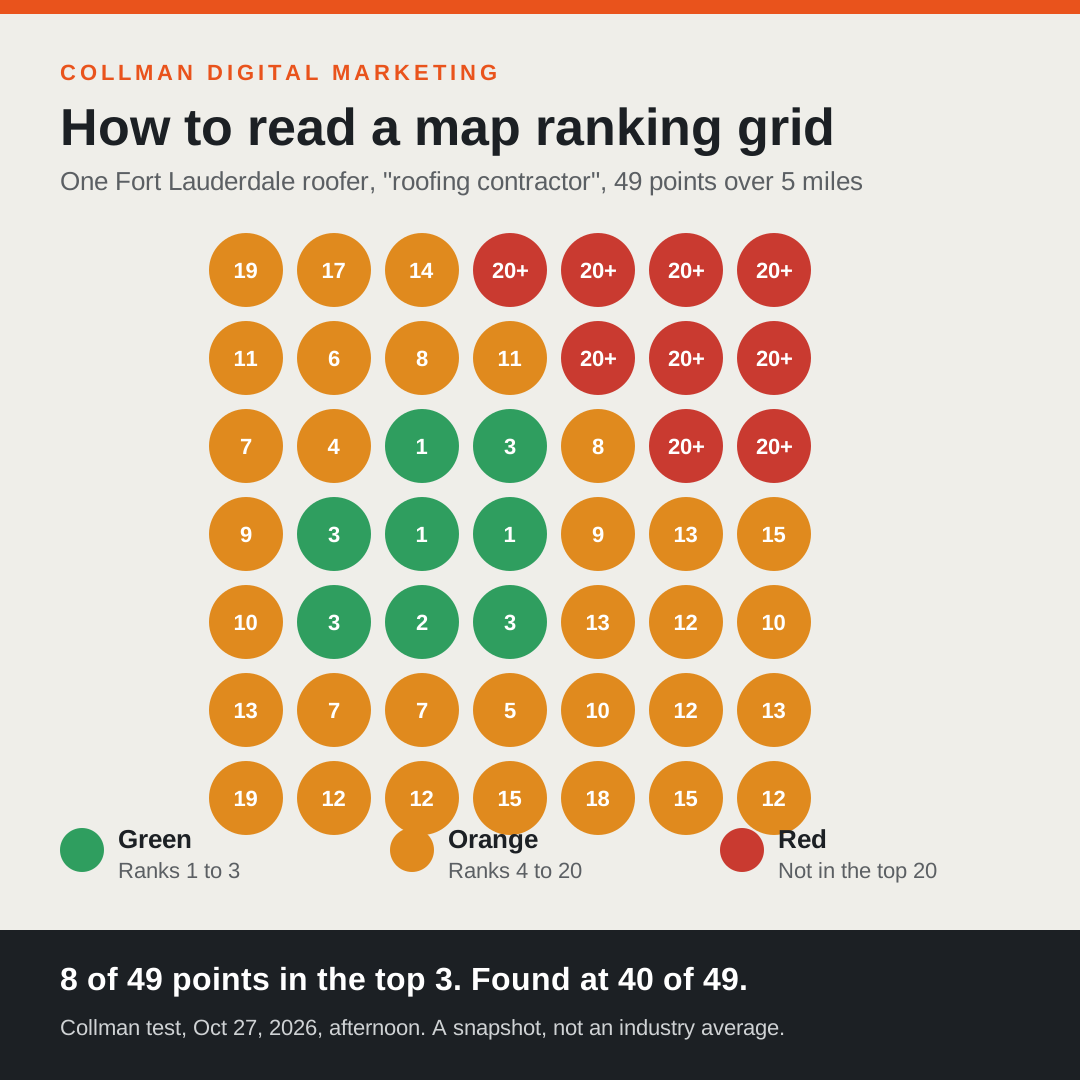
We ran a public-data test on one Fort Lauderdale roofing company with several hundred Google reviews. For the search “roofing contractor” it appeared in the top 3 at 19 of 49 points and was found at all 49. For “roof repair near me” it was in the top 3 at only 6 of 49 points and missing from the top 20 at 10. Same business, same day, very different picture. This is one business tested in October 2026, not an industry average.
“roofing contractor” · one Fort Lauderdale roofer · 7 x 7 points over 5 miles · Oct 27, 2026
How do you read the colors?
Green means you rank 1 to 3 at that point. Orange means you rank 4 to 20. Red means you are not in the top 20 there. Read the grid for patterns. A strong center that fades toward one side usually means the business is weaker in that direction, and the fix is local, not national.
What moves your map ranking?
Contractors move their grid by earning and answering reviews, keeping the business listing accurate and complete, choosing the right categories, and building pages that name the towns they serve. Distance from your address is the one factor you cannot change, which is why a grid is more honest than a single ranking. See Google's tips to improve your local ranking.
How does ranking turn into booked jobs?
A ranking only helps if the call is answered. Our AI receptionist answers every inbound call in under 60 seconds, 24 hours a day, including nights and weekends. It books the appointment on your calendar and sends you a summary. It tells callers it is an AI when asked, and it handles inbound calls only.
Not everyone books on the first call. It captures the caller's email address and starts an automatic follow-up sequence, so leads who are not ready yet keep hearing from you until they book. We cannot promise results, but we can make sure the calls your ranking earns do not go to voicemail.
Don't take our word for it — call it.
Riley, our AI Inbound Receptionist, is answering a live line right now. She is set up for a roofing company. Tell her what kind of business you run and she answers as one.
Call Riley: (754) 220-5858